
AI Features Overview
Introduction
The AI Assist helps users by providing guidance on CDP Studio usage, CDP Framework features, UI configuration, code syntax, and general engineering problems. It supports assisting with no-code project Configuration and for software code development.
AI Features
CDP Studio AI features provide a powerful set of tools to enhance your development experience.
- Ask the AI Assist general help on CDP Studio, CDP Framework features, UI widgets, and general engineering problems.
- No-code programming: ask the AI Assist to solve problems and to add configured no-code blocks to your project.
- Software code development: ask the AI Assist to write code, propose changes, and review them before anything is updated.
- Issues: ask the AI Assist to track down problems and errors.
- GitHub Copilot integration: an extension to the built-in AI code assistant, add your GitHub Copilot license key to get Copilot in Code mode.
Unlike general-purpose AI systems, CDP AI Assist works within a well-defined development context. It understands the structure, components, and workflows of your CDP Studio project, including your project-specific components and resources. When making changes, it operates through trusted, built-in CDP mechanisms rather than making arbitrary file edits. This controlled approach helps ensure consistency, traceability, and safety, making AI Assist a more reliable and secure partner for developing and evolving your systems.
AI Assist
The AI Assist is designed to make developing systems faster and easier. It serves as your personal CDP Studio expert, drawing on the full breadth of CDP Studio documentation, features, and best practices. Equipped with tools to generate no-code blocks or software code, the AI Assist is there to save you time and effort—helping you focus on innovation rather than routine tasks and research. Whether you’re new to CDP Studio or an experienced user, AI Assist delivers step-by-step guidance and quick answers to your questions, so you can move forward with confidence.
The AI Assist is available to all users. The software code assist and the advanced mode with deeper reasoning and more sophisticated capabilities are exclusively available to commercial subscribers. With the Advanced mode, you can expect more nuanced assistance, and a greater depth of context to address complex technical challenges.
Advanced mode benefits include:
- Deeper reasoning capabilities
- Enhanced technical understanding
- Greater depth of context
The Local Shell Tools option benefits include:
- Allows the AI to work on project files that are not exposed in the project, eg HMI files,
- Enables advanced terminal-based work, such as helping with Git or checking Git status, looking at hidden files
- The AI may ask for access if it would be helpful in completing tasks
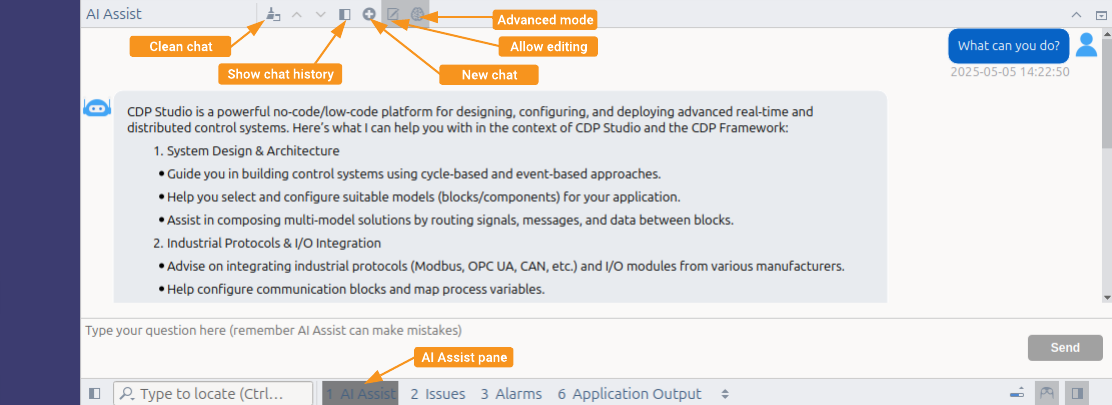
Note: Changes made by AI Assist can be reverted with the undo command (Ctrl+Z).
How-To Questions
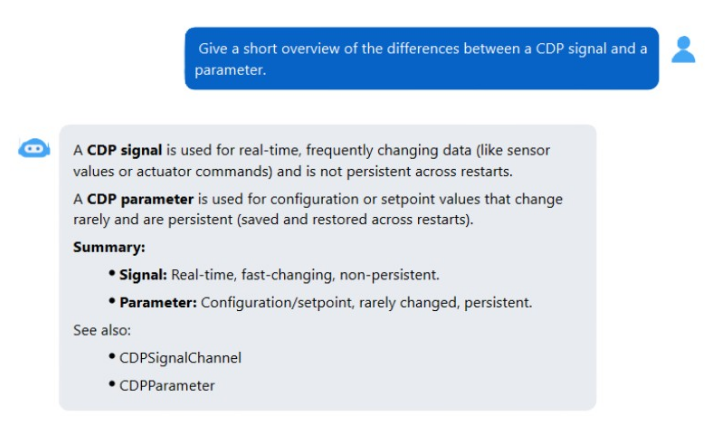
We’ve all been there: you know what you want to achieve, but you’re not quite sure how to get there. With AI Assist, you can simply ask “How do I…?” and get concise, relevant explanations tailored to your context. hether it’s configuring a particular part of the CDP Framework, setting up communication protocols, or following best practices for secure deployments, AI Assist can walk you through the process step by step.
- Immediate Help: Save time by getting direct answers to common queries, so you don’t have to sift through multiple resources.
- Context-Aware Guidance: AI Assist interprets your question in the context of your project and development environment, providing customized tips and instructions.
- Learning as You Go: Turn everyday questions into learning opportunities—quickly pick up new frameworks, libraries, or features that enhance your development workflow.
AI-Assisted No-Code Programming
One of the most powerful features of the AI Assist is its ability to generate no-code (or low-code) blocks that can be directly integrated into your projects. This functionality dramatically lowers the barrier for rapid prototyping, allowing you to build out core system components without writing a single line of code.
- Visual Workflow: Turn complex logic into drag-and-drop elements that can be configured without delving into syntax details.
- Rapid Prototyping: Quickly experiment with different setups, saving you time in preliminary development.
- Scalable Architecture: Easily switch between no-code blocks and deeper code-based logic when you need to enhance or expand functionality.
By streamlining routine tasks and eliminating repetitive coding, AI-assisted no-code programming empowers you to focus on what truly matters—innovative features and robust system design.
Troubleshooting In Project
The AI Assist can also help you troubleshoot issues in your project. Whether it’s a missing configuration, a syntax error, or a logic flaw, the AI Assist can analyse different tool logs, application outputs and runtime alarms. It can then suggest potential fixes or indicate where to look for the problem.
Example
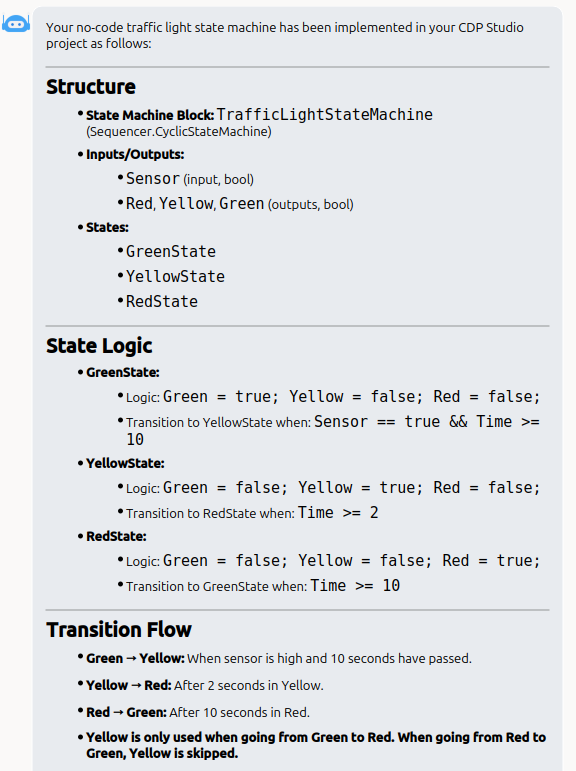
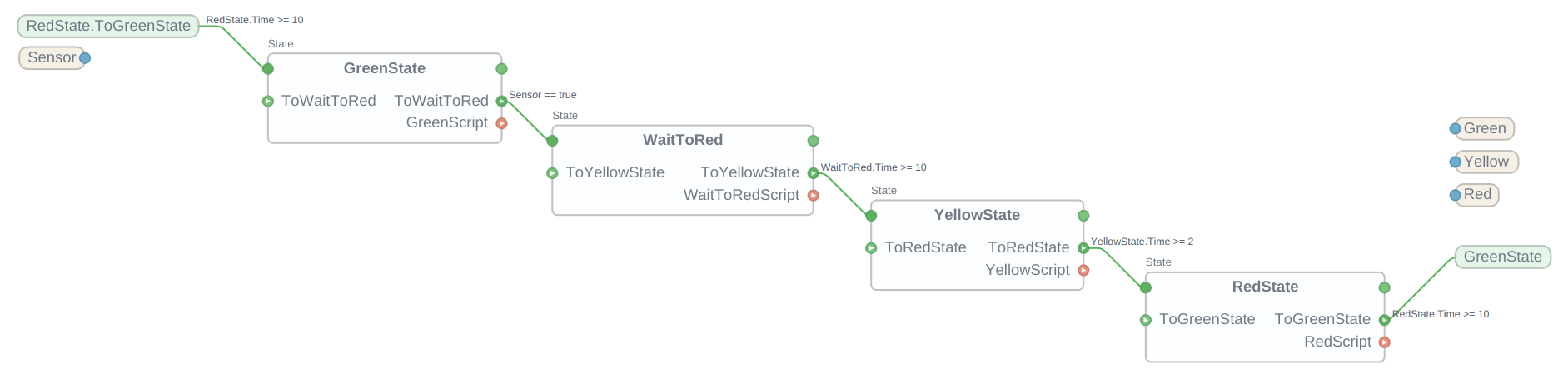
This example shows how to use the AI Assist to create a state machine for a traffic light system.
| I need a no-code state machine for traffic light with sensor input and outputs for red, yellow, green. I want the yellow to be on for 2s when the light is going to red and the yellow to be skipped when going green. Turning red should start 10s after sensor input goes high and after 10s being red the light should go back to green. |
| Build this for me |

AI Proposing a solution
AI implementing and explaining it
AI Assisted software/code development
AI-assisted software programming or code assistance in Code mode comes in two forms:
- CDP AI Assist: Your personal developer assistant in the AI Assist pane
- GitHub Copilot: AI-driven code suggestions embedded in the code editor
The CDP AI Assist has knowledge of the CDP context, structure, and dependencies and has access to CDP documentation. This extends AI assistance beyond code support with the ability to also create and update models and header files simultaneously to achieve fully functional CDP components and objects. The CDP AI Assist works according to a developer’s workflow, by writing or updating code and creating a diff view for you to review (like an internal pull request). Here, you can request improvements or make manual changes before merging them into your source code. This keeps you in full control of all code and model changes.
The GitHub Copilot, if enabled by linking your account, gives AI-driven code suggestions, syntax and best practices, and for debugging and improvements. See how to integrate GitHub Copilot.
Code AI Assist in the AI Assist Pane
In Code mode, you can ask AI Assist to prepare concrete code changes and then review them before anything is written to your files. The review happens in the AI Assisted Edit diff, where you can inspect the proposal, comment on specific lines, and decide whether to apply or decline it.
How to Activate Code AI Assist
Code AI Assist is available when all of the following are true:
- You have a commercial license.
- The active project is a library project.
- CDP Studio is in Code mode.
You can activate it in two common ways:
- From the AI Assist pane: type a coding request and send it.
- From the editor: select code and use the AI selection mark to open the inline Ask/Edit prompt.
When you work directly from the editor, select the code you want to work on. The AI selection mark appears next to the selection. Click it to open the inline prompt, describe what you want to do, and then choose:
- Ask to ask about the selected code.
- Edit to request a concrete code proposal.
Keep New task checked when you want the request to start in a separate chat.

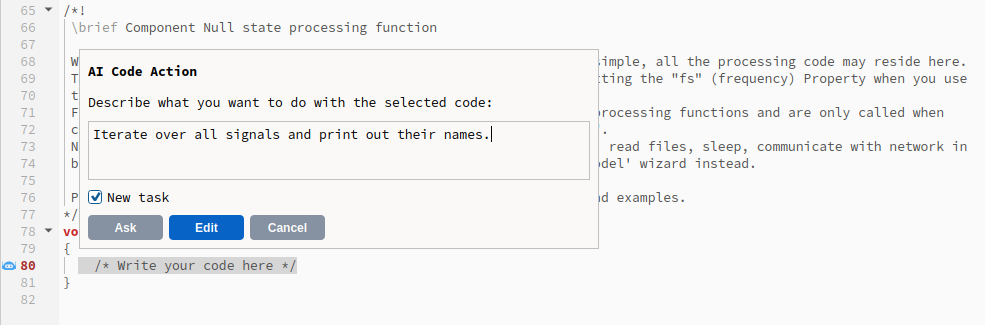
Select code to make the AI action icon available
Describe the change and choose Ask or Edit
Opening the AI Assisted Edit Diff
After you send an edit request, AI Assist continues working in the chat. When a code proposal is ready, a notification appears with a View button. Click View to open the AI Assisted Edit diff.
In the diff view, the left side shows the current code and the right side shows the AI proposed code. The banner at the top summarizes the proposal, and the toolbar lets you adjust the review view, for example by changing context lines or whitespace handling.
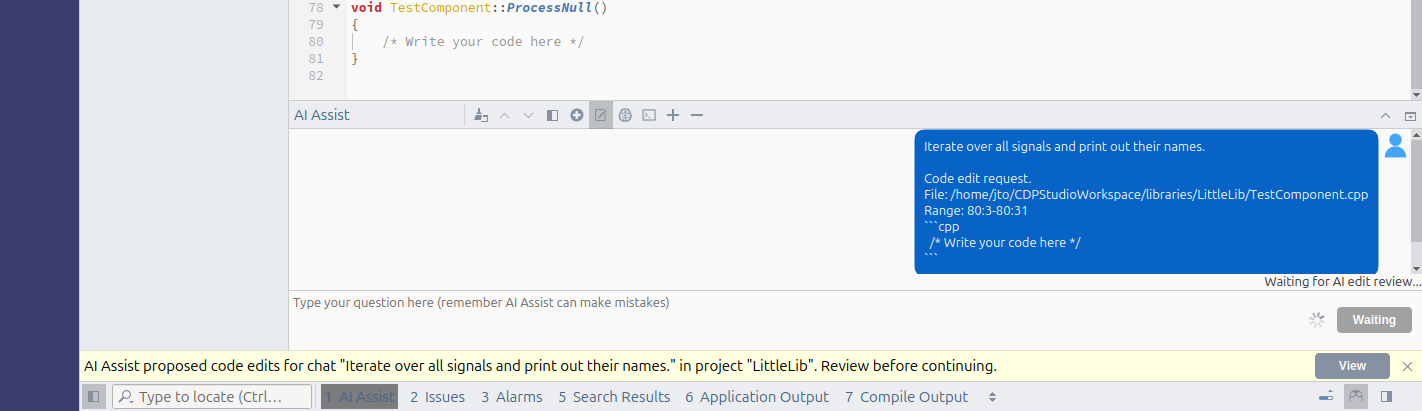
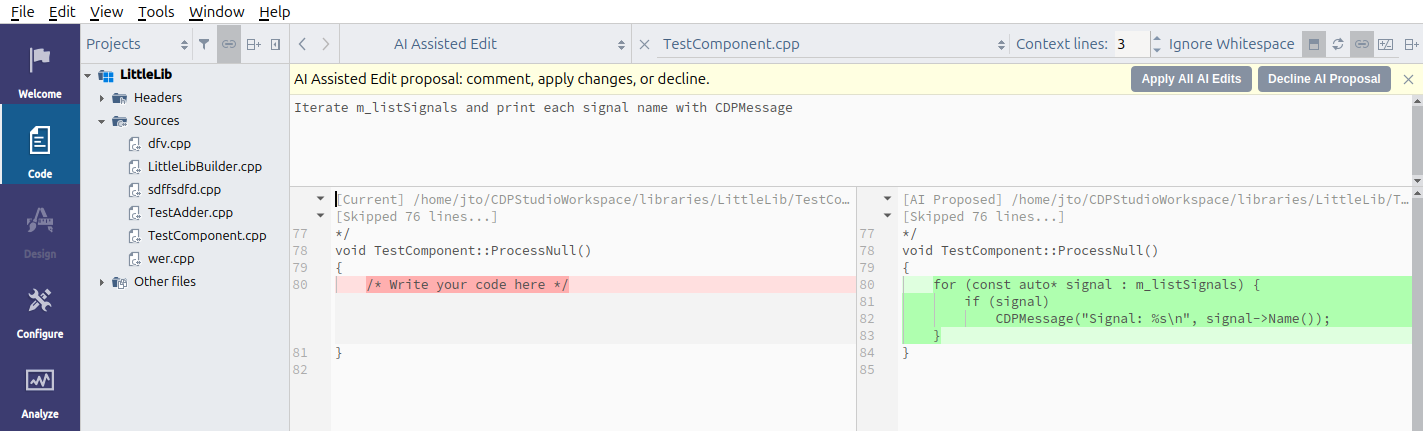
AI Assist notifies you that a code proposal is ready for review
Click View to open the AI Assisted Edit diff
Adding, Editing, and Removing Diff Comments
Before you accept or decline the proposal, you can add comments directly to specific lines in the diff:
- Select the relevant diff lines and use Add AI Comment for Selection... from the diff context menu.
- Or click the AI comment mark shown for the current diff selection.
- Enter your comment and click Save Comment.
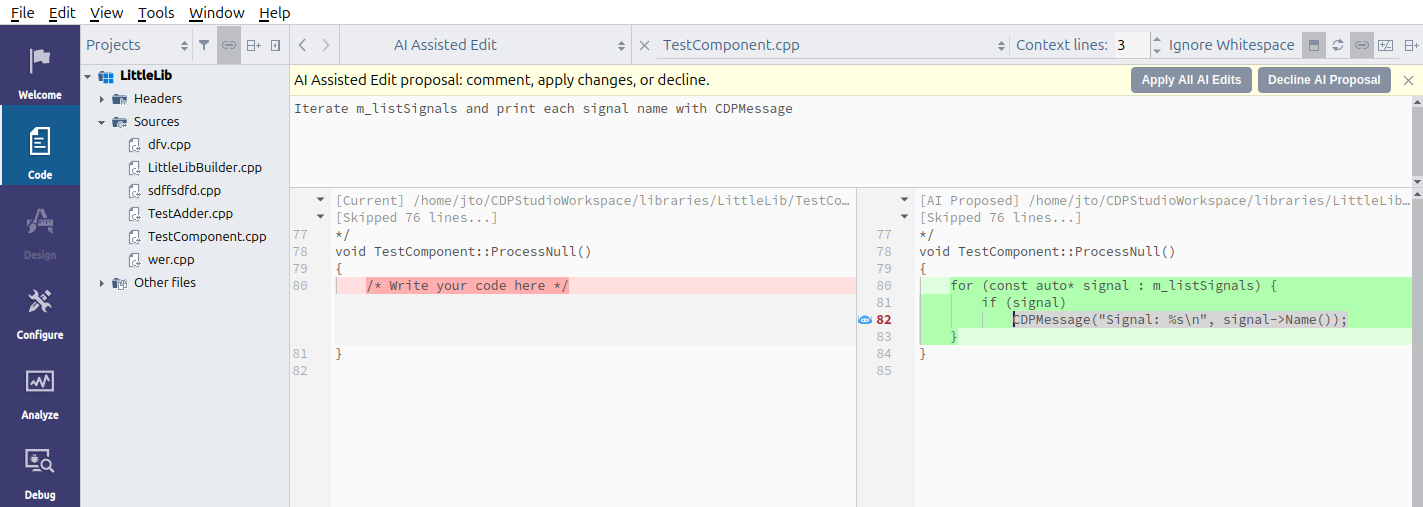
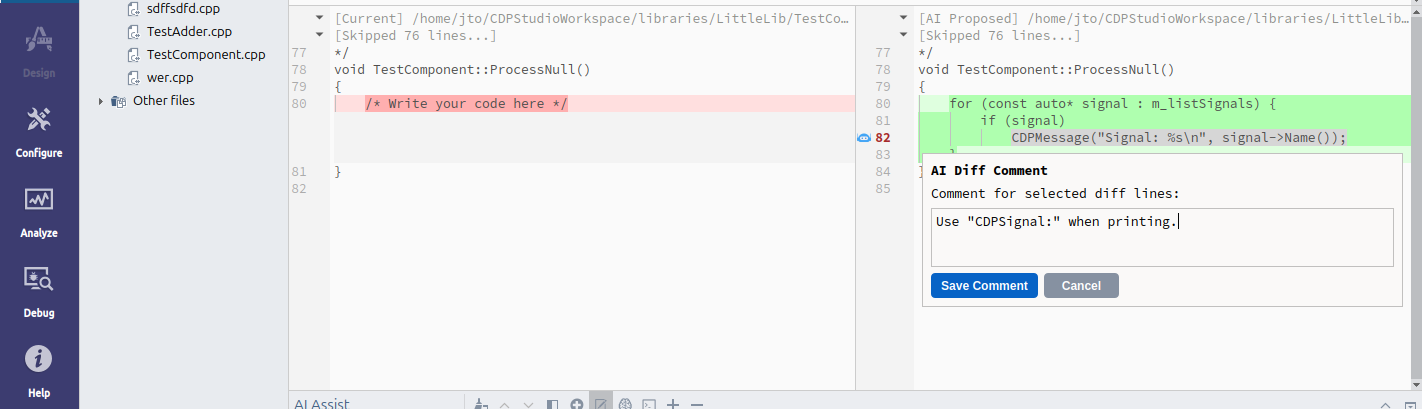
Select the changed lines you want to comment on
Write the comment for the selected diff lines

To edit a comment, click its inline annotation, change the text, and click Save Comment. To remove a comment, open it and click Cancel. To leave the comment unchanged, click Close.
Resolving the Proposal
When you are done reviewing, use Apply All AI Edits or Decline AI Proposal. If you want to accept only one file, use the diff context menu and choose Apply AI File.
- Apply All AI Edits without comments: The proposed changes are applied to your code. No follow-up AI work is started.
- Apply All AI Edits with comments: The proposed changes are applied, and AI Assist starts a new follow-up task using your comments to tailor the code further.
- Decline AI Proposal with comments: The proposed changes are not applied. AI Assist continues working on the request and revises the proposal using your comments.
- Decline AI Proposal without comments: The proposed changes are not applied and no further AI work is started.

Summary
With the combined power of AI Assist and GitHub Copilot, you can seamlessly transition from simple no-code blocks to advanced coding tasks, while retaining consistent guidance and an uninterrupted development flow.
By leveraging the capabilities of the CDP Studio AI Assist—from how-to tips and no-code generation to intelligent coding support — you can accelerate your development process and streamline your workflow. Whether you’re an enthusiast, a startup, or an enterprise user, AI Assist has the tools and intelligence you need to make building sophisticated systems simpler, faster, and more intuitive.
Note: The AI Features may make mistakes. Neither CDP Technologies nor the underlying AI engines use your data for training.
Get started with CDP Studio today
Let us help you take your great ideas and turn them into the products your customer will love.